Based in Maple Ridge · serving Vancouver & the Lower Mainland
Mon to Sat, 8 to 6
Travertine
Travertine is softer and more porous than marble, which means it marks more easily and asks for a slightly different touch.
Free estimate, on site, with no obligation.
This is the travertine call we get more than any other, so it goes first.
Travertine forms with natural voids running through it. Before a slab or tile is installed, those voids are filled at the factory so the surface arrives smooth. Years of use later, that fill starts working loose and popping out, and you are left with small pock marks scattered across a floor or a counter.
Nothing has gone wrong with your stone. It is doing what travertine does. The fill was always a separate material from the stone around it, and it has a shorter life than the stone does.
The repair is straightforward: the open voids are refilled with a colour-matched material, left to cure, then ground back flat with the surface so the floor reads level again. On a floor with a lot of them it is done as a pass across the whole area rather than hole by hole.
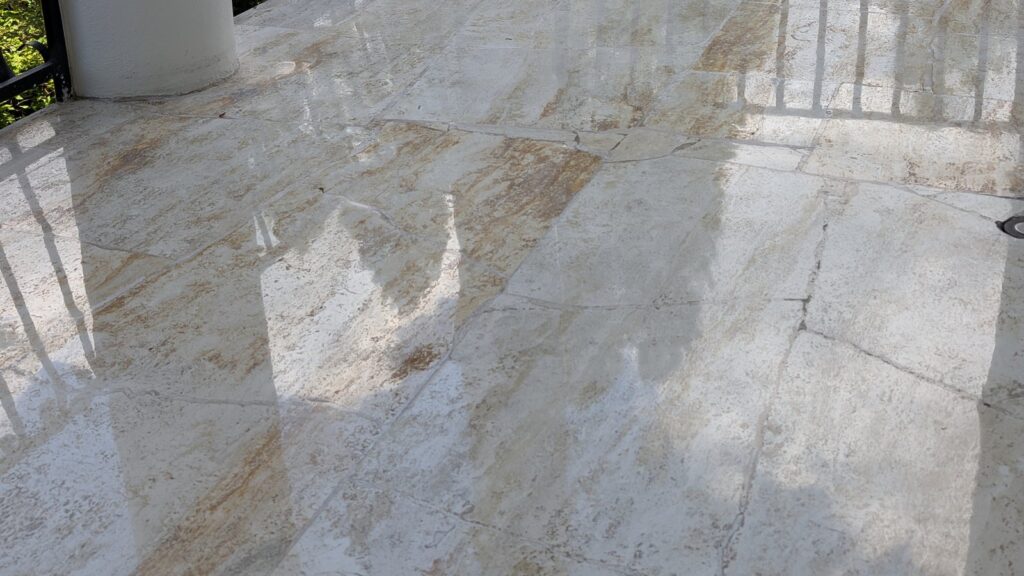
Etching is the usual answer, and travertine etches more readily than marble because it is softer. Wine, citrus, vinegar, or a cleaning product that was never meant for stone. The mark reads dull against the surface around it, and no amount of cleaning brings it back, because the finish has gone rather than being covered.
Traffic wear is the other one, and on floors it is the bigger problem. Grit tracked in acts as an abrasive, and travertine’s softness means it flattens faster than marble under the same use. You will see a path form where people walk while the edges keep their finish.
If your travertine still looks dull once it is properly clean, that is the surface rather than dirt, and it needs polishing.
Not sure whether a mark is an etch or a stain? They need opposite treatments. Our etch removal page goes through how to tell.
Need help with travertine cleaning and repair?
The same two-stage job as any stone, with one difference worth knowing.
Honing takes the surface down past the damage with progressively finer diamond abrasives, run wet. Polishing follows: a powder worked in with water and buffed until the stone reflects.
Because travertine is soft and porous, a honed finish often suits it better than a high polish, particularly on a floor. A full gloss can look harsh on it and it wears off faster under traffic than it would on marble. On a quiet counter or a feature wall, polish may be exactly right. It is worth a conversation before we start, since the finish decides how the stone looks and how it holds up for years.
Sealing matters more on travertine than on most stone, because it drinks faster. A penetrating sealer slows liquids on the way in and buys you time to wipe a spill. It does not make travertine stain-proof, and it does nothing at all for etching.
Nothing is quoted over the phone. Travertine has natural fill lines and texture that photograph like damage, and real damage that photographs like nothing.
Dust free throughout. Water holds the dust down and what is left is captured at the tool.
On timing: a counter can be a few hours. A floor runs from a day to a week depending on size and how many holes need filling, with wood and carpet protected throughout. Your quote has the real number.
Travertine gone dull, or holes opening up?
778-862-4998
We work through Vancouver and the Lower Mainland: Yaletown, Coal Harbour and False Creek, downtown and the West End, Shaughnessy, Kerrisdale, Point Grey, Kitsilano and Dunbar, West Vancouver and the British Properties, North Vancouver, Burnaby, the Tri-Cities, Richmond, Surrey and White Rock, plus Whistler for commercial work.
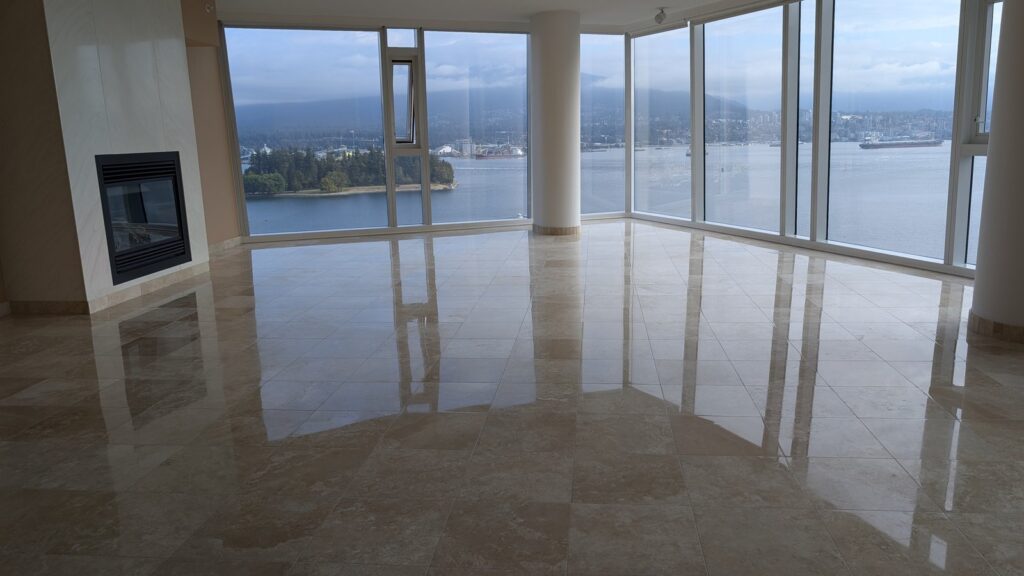
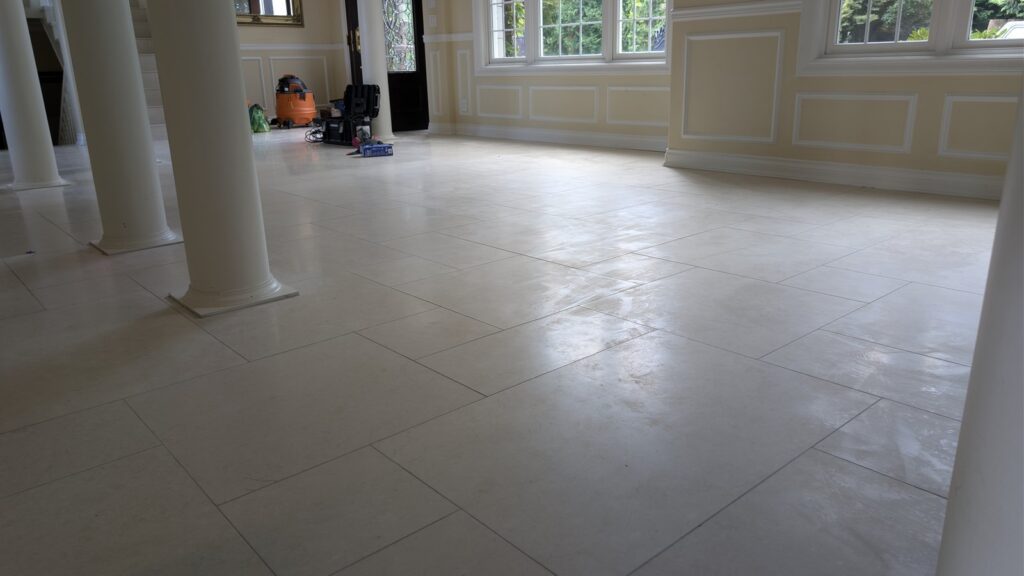
In homes, travertine turns up on entry floors, bathroom floors, shower surrounds and patios. In strata buildings and hotels it is common in lobbies and common areas, where the wear pattern is different: a dull path forms door to elevator while the corners stay bright, and the holes open up faster under that much traffic. Rain and grit tracked in from October through March do most of the damage.
What moves the price: the size of the area, how bad the damage is, how many voids need filling, the stone and the finish. Our pricing page has the breakdown.
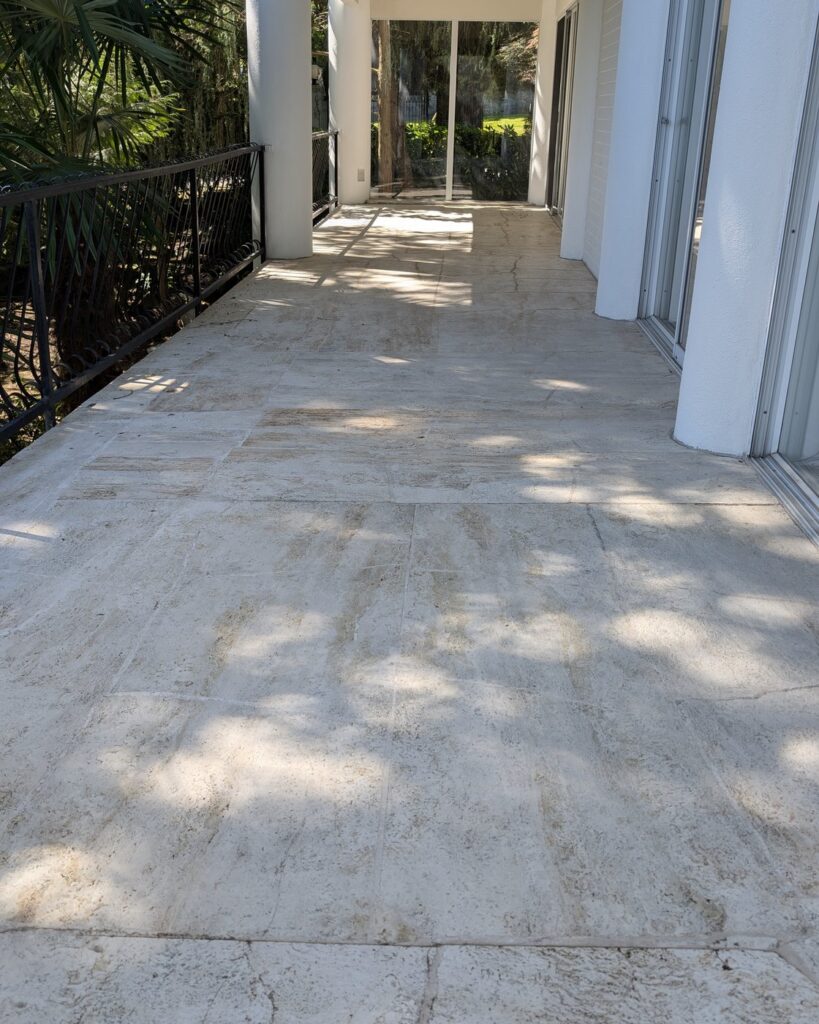
Before
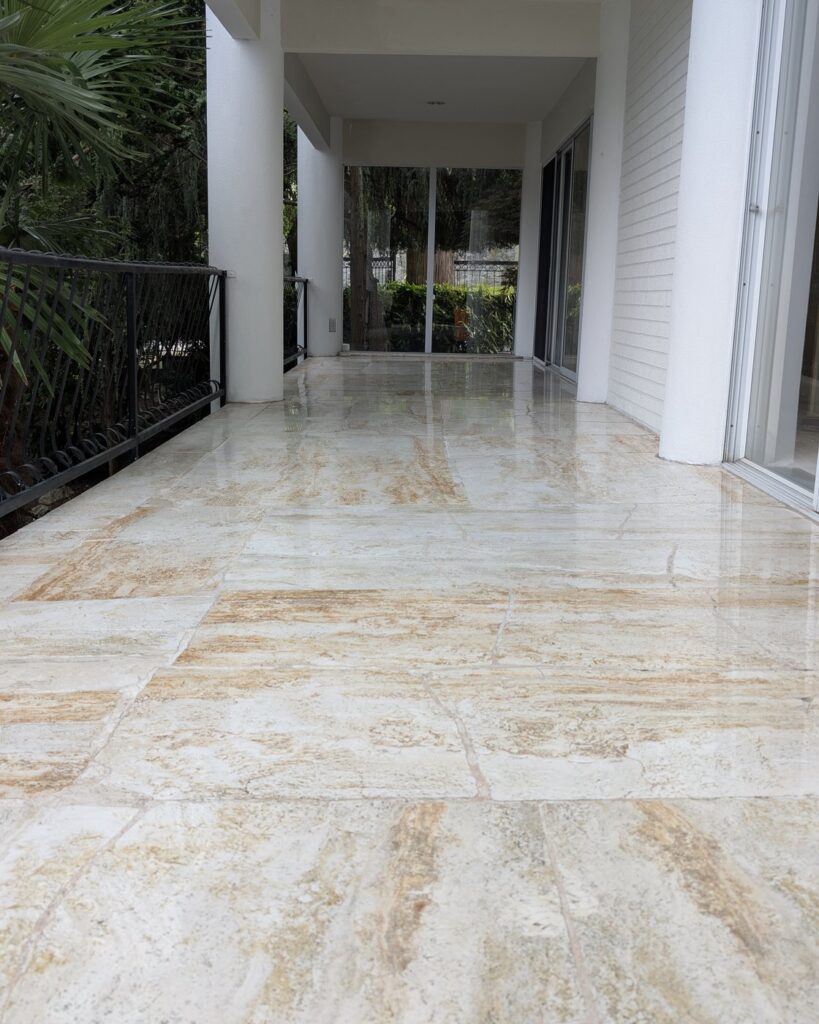
After
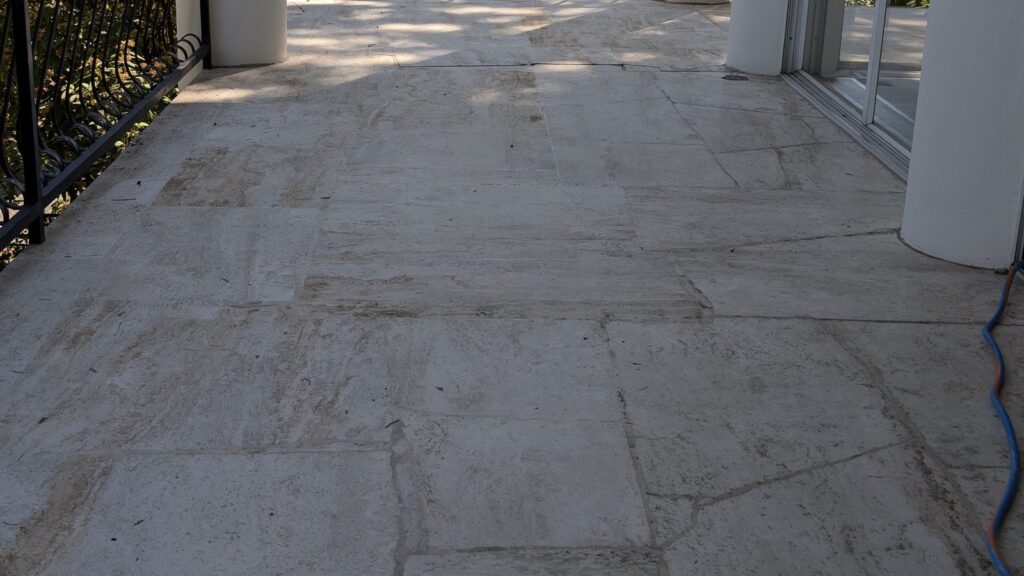
Travertine walkway, Point Grey. Filled, honed and polished over three days.
No, they are original to the stone. Travertine forms with natural voids, and those get filled at the factory before installation so the surface arrives smooth. Over years of use that fill works loose and pops out, leaving pock marks. It is one of the most common travertine calls we get, and the fix is to refill the voids with a colour-matched material and grind the surface back level.
Look at the shine rather than the colour. An etch is the same colour as the stone around it but flat, and it takes the shape of whatever sat there, so a glass leaves a ring. A stain is darker but still glossy, with an edge that spreads and feathers. Travertine’s porosity means it is prone to both, and they need opposite treatments, so it is worth getting right before anyone touches it.
If it still looks dull once it is properly clean, cleaning has done its job and the problem is the finish. On travertine that is usually etching from something acidic, or traffic wear, which happens faster than on marble because the stone is softer. Neither comes back with a product. Both come back with honing and polishing.
Honed suits most travertine, particularly on floors. A high polish can look harsh on a stone with this much natural texture, and it wears off faster under traffic than it would on marble. On a quiet counter or a feature wall a polish can be right. We will tell you which we would choose for your space and why, before any work starts.
It helps. Travertine is porous, so it absorbs faster than marble or granite, and a penetrating sealer slows liquids on the way in, which buys you time to wipe a spill up. What it will not do is make the stone stain-proof, and it does nothing at all to prevent etching, because etching is acid reacting with the stone itself rather than something sitting on the surface.
Yes. The work is dust free, so there is no cloud of stone powder settling on furniture, and the area gets contained while we work. In hotels and strata buildings it is usually scheduled overnight or in quiet hours so foot traffic keeps moving. Commercial floors get read as a whole surface first, because polishing only the worn path leaves a sheen that never matches the rest.
Send a photo or call. We will look at it on site and tell you honestly whether it is worth doing.
Free estimate. No obligation.