Based in Maple Ridge · serving Vancouver & the Lower Mainland
Mon to Sat, 8 to 6
Marble repair
A chipped edge, a crack running out from a sink cutout, a hole that has opened up in a travertine floor. These are repairs rather than restoration: something is missing from the stone and it has to be put back.
Free estimate, on site, with no obligation.
They look related and they are not fixed the same way.
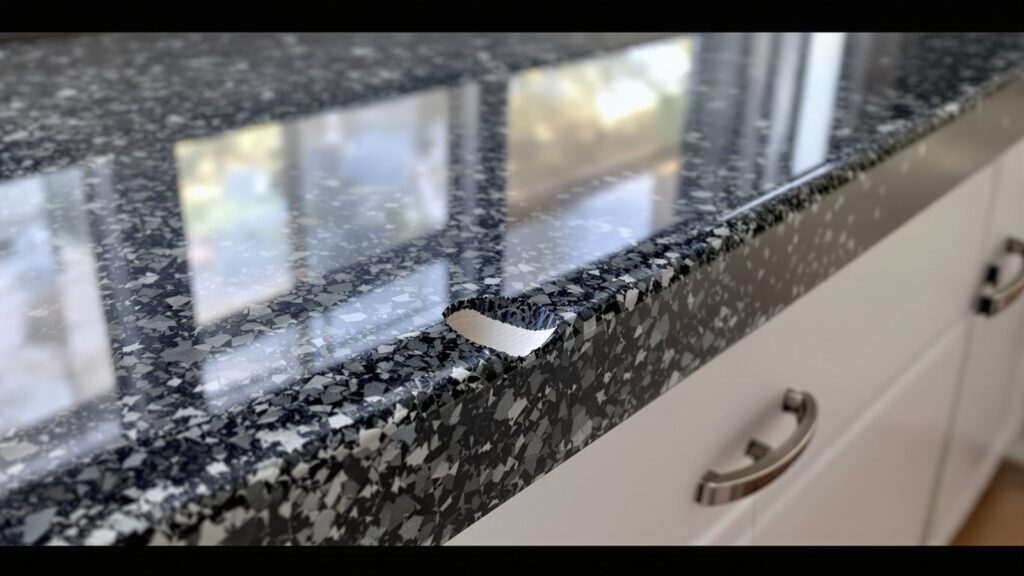
A chip is missing material. A dropped pan, a knocked-over bottle, movers catching a corner. Most of them are on an edge or a corner, because that is where stone is most exposed. A chip is contained: it is not going to spread on its own.
A crack is a split. It usually follows a seam or a natural vein where the stone was already weaker, and it often starts near a cutout, where the slab is under the most stress. A crack needs stabilizing before anything else, because unlike a chip it can keep moving.
Holes are mostly a travertine thing. Travertine forms with natural voids, and they get filled at the factory before it is installed. Years later that fill starts popping out, and you are left with pock marks across the surface. It is one of the calls we get most often on travertine, and it is a straightforward fix: the voids get refilled and the surface brought back level.
This is the part worth understanding before you call, because it explains the shape of the quote.
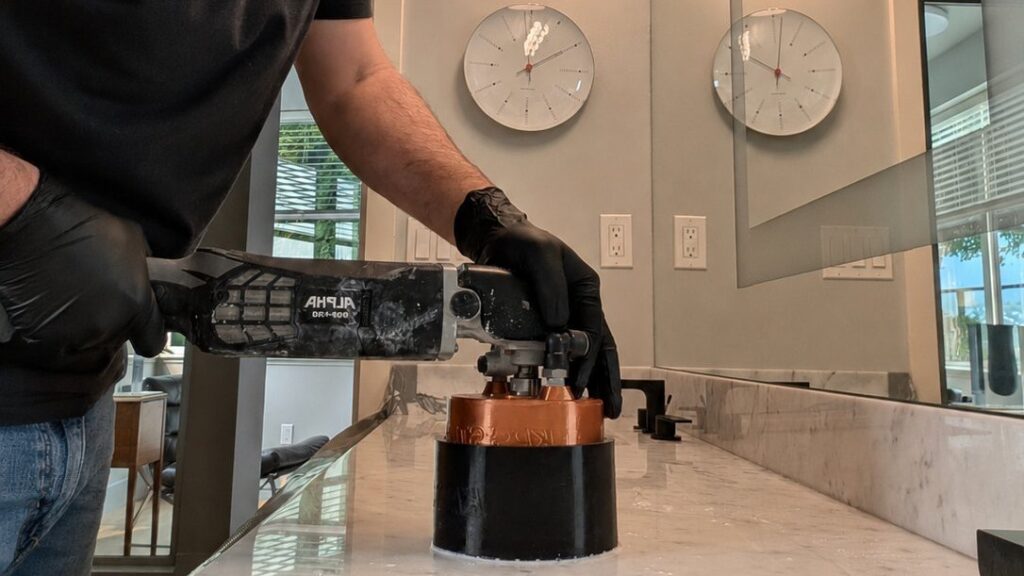
The damage is filled with a resin colour-matched to your stone. We overfill deliberately, so there is material proud of the surface, then let it cure hard. Once it has, the excess is ground back flat with the stone around it.
Then comes the part most people do not expect. That patch of stone is now perfect. If the surface around it is even slightly worn, and on anything that has been in use for a few years it will be, the repair now looks newer than everything next to it. The repair is invisible; the contrast is not.
So fixing a crack properly usually means refinishing a larger area, or the whole surface, so it all reads the same. On a newer installation there is less to match and a single spot can be worked in. On stone that has been living in a kitchen for a decade, the honest answer is the wider area.
We would rather tell you that up front than surprise you with it in the quote. It is also why the size of the surface is one of the things that moves the price.
Need help with marble chip and crack repair?
On this page: chips, cracks, breaks and holes in marble, limestone and travertine, on countertops, islands, vanities, floors, thresholds and table tops.
Not sure which one you have? Send a photo. It is usually obvious from a picture, and it saves everyone a visit.
Almost always repair, and the reason is structural. Marble is solid stone the whole way through, not a veneer over something else, so a chip or a crack is damage to a piece of stone rather than a failure of the whole slab.
Where replacement genuinely comes into it is a slab split right through end to end, a section that has broken away entirely, or stone that is moving because whatever is underneath it has failed. That is a different trade and we will tell you so.
Everything short of that is worth looking at first. It costs nothing to have it seen.
Nothing is quoted over the phone. Photos flatten depth, and a hairline crack in a picture can turn out to run further than it looks.
Dust free throughout. Water holds the dust down and what is left is captured at the tool.
On timing, a single chip is often a few hours. Where it takes longer is the refinishing around it: a large kitchen can run to two days plus a return visit to seal. Your quote carries the real number.
Chipped, cracked, or holes opening up?
778-862-4998
We work through Vancouver and the Lower Mainland: Yaletown, Coal Harbour and False Creek, where the towers from the boom years have stone now 15 to 30 years old and edges that have taken a knock or two · the West End · Shaughnessy, Kerrisdale, Point Grey, Kitsilano and Dunbar, where character homes have original marble entries, hearths and table tops · West Vancouver and the British Properties · North Vancouver, Burnaby, the Tri-Cities, Richmond, Surrey and White Rock · downtown hotels and strata buildings, and Whistler for commercial work.
What moves the price: the size of the surface, how bad the damage is, the stone itself and the finish. Our pricing page has the breakdown and the minimum service call.
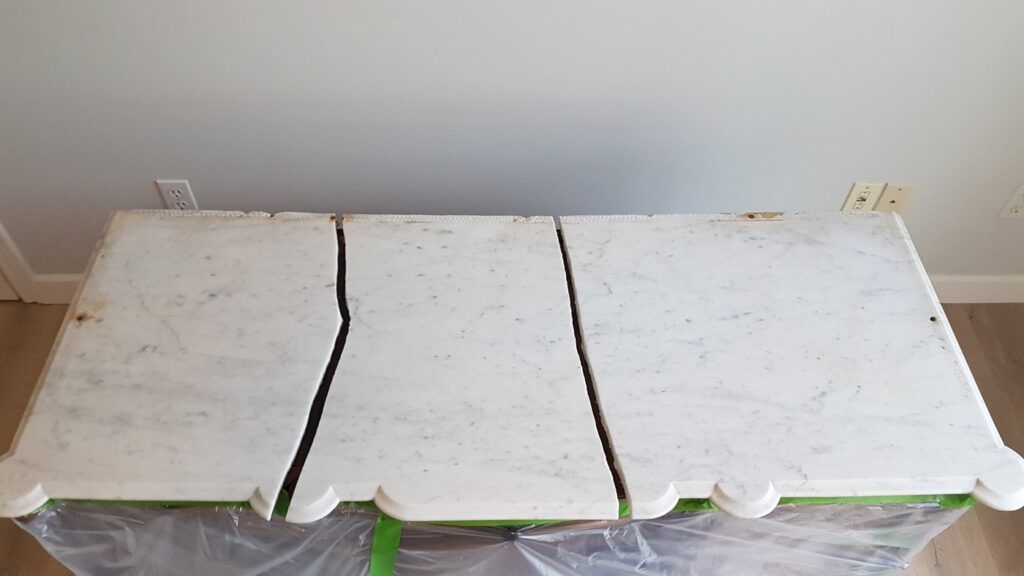
Before
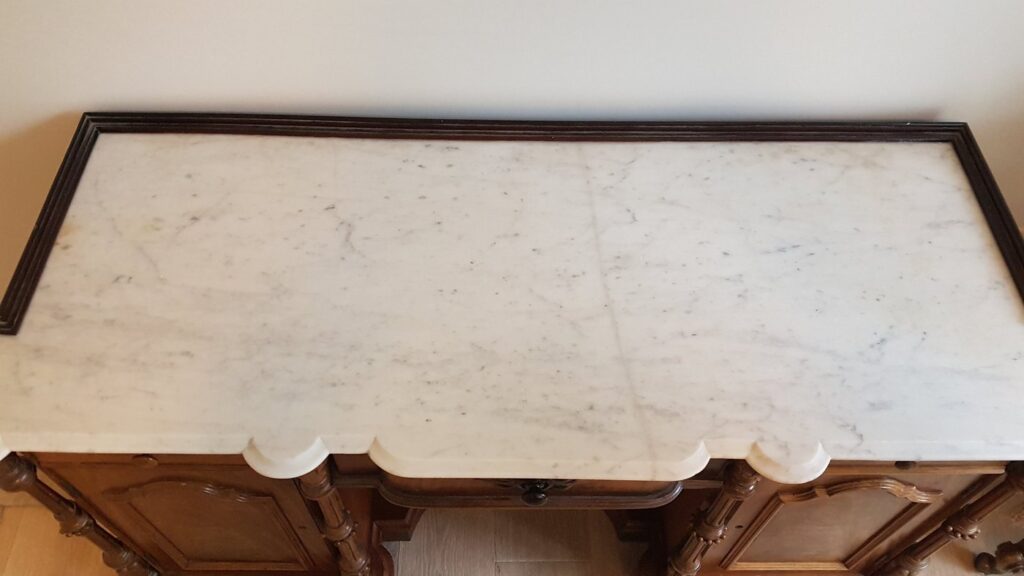
After
Antique cabinet top, broken in three. Bonded, filled, ground flat and polished, then back on the cabinet.
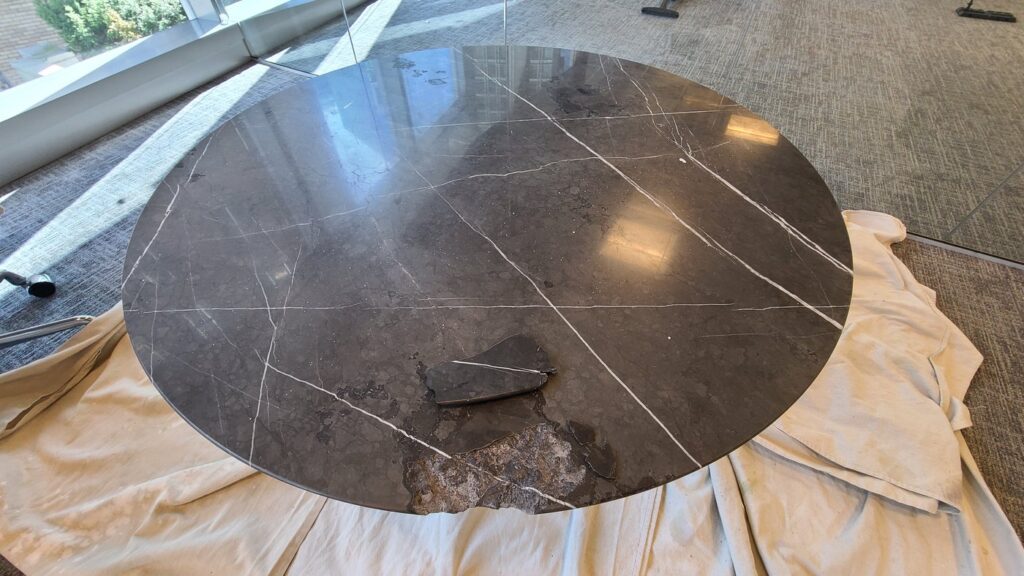
Before
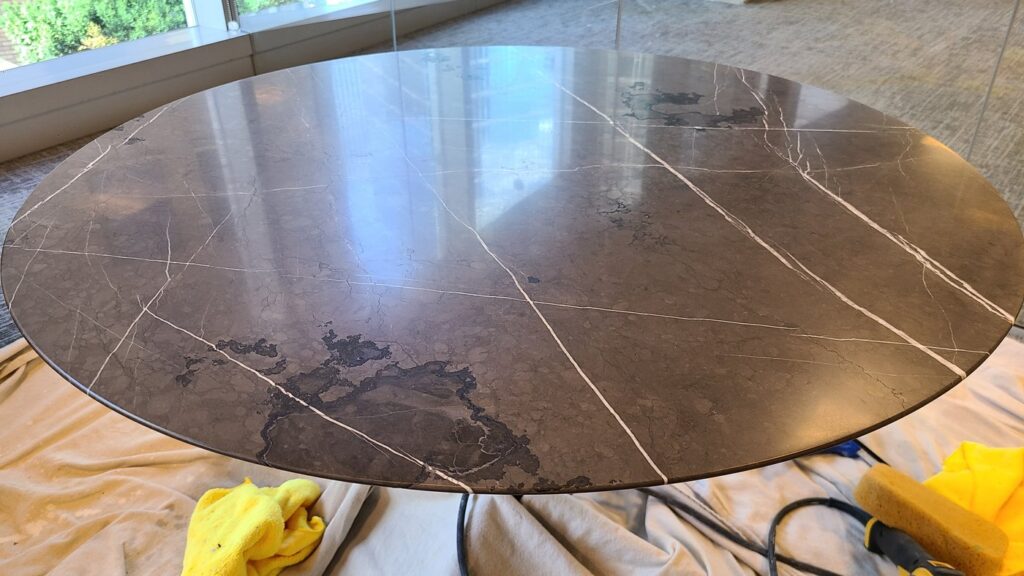
After
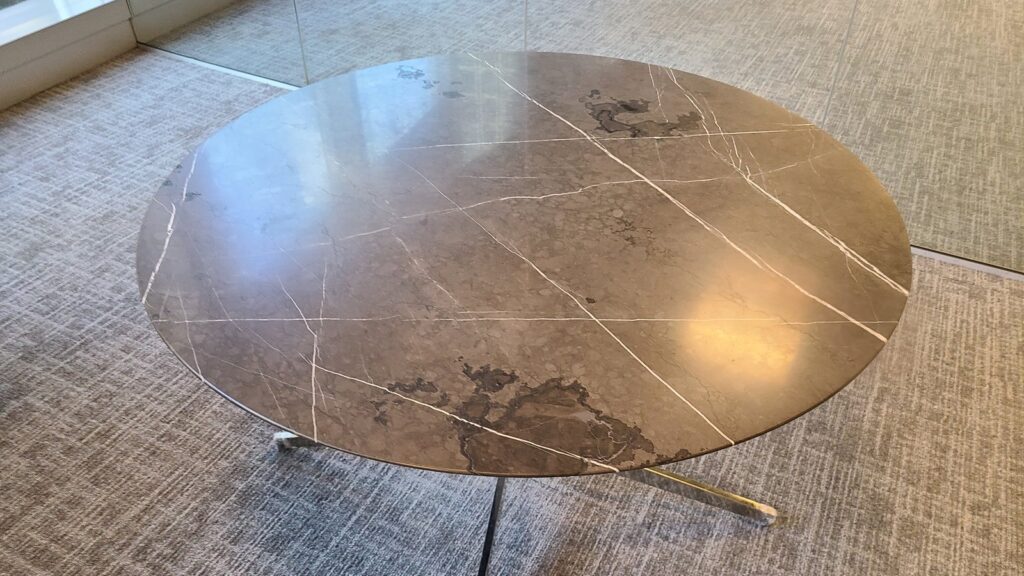
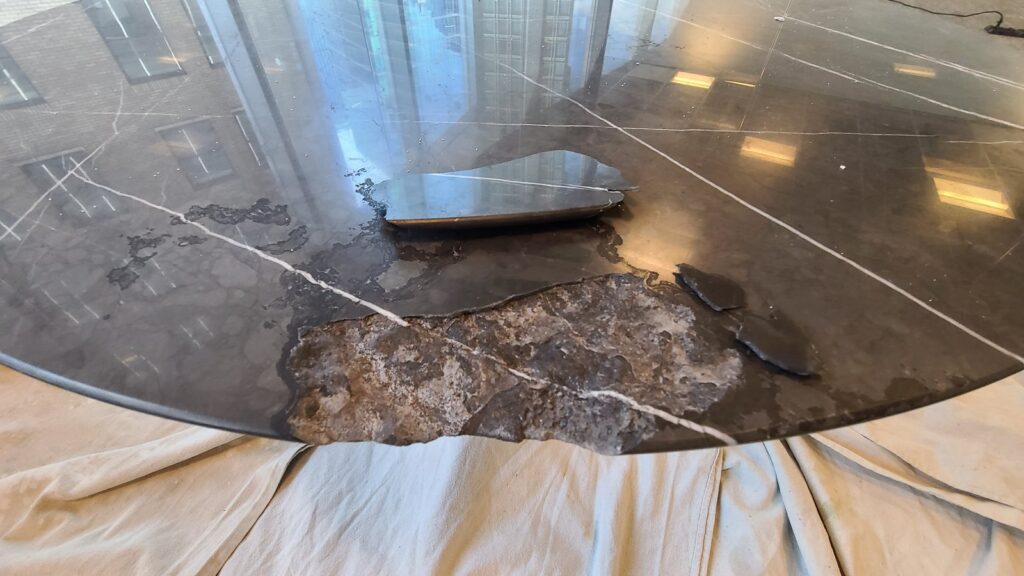
Round marble table with a chunk missing. Rebuilt and blended on the same visit.
The crack is stabilized first, because unlike a chip a crack can keep moving, and polishing over one just hides a problem that is still going. Then it is filled with a resin matched to the colour and pattern of your stone, deliberately overfilled, and left to cure hard. Once it has, the excess is ground back flat with the surface. In most cases the area around it is refinished afterwards so the repair does not end up looking newer than everything beside it.
Repaired, in almost every case. Marble is solid stone the whole way through, so a chip is damage to one part of a slab rather than a failure of the whole thing. It gets filled with colour-matched resin, cured and ground flush. We have never seen anyone need to replace a counter over a single chip. Replacement only comes up when a slab is split end to end, a section has broken away, or the stone is moving because the substrate under it has gone.
If a piece has broken clean off and you still have it, then yes, a proper stone epoxy will bond it, and that is genuinely part of the job on a broken table top or a snapped corner. What matters is what happens afterwards. The join has to be levelled and the finish brought back across it, or you end up with a repair you can see from the doorway even though the pieces are together. Household adhesives are the thing to avoid: they discolour, they sit proud of the surface, and they usually have to be ground off before a real repair can start.
The right answer is a colour-matched stone resin rather than any general-purpose glue, and the colour matching is most of the skill. A clear or white filler in a dark veined marble reads as a scar. If you are set on trying it yourself, use a product made specifically for natural stone, work in good light, and accept that the visible part is not the bond, it is the finish afterwards. That is the step that decides whether anyone can find the repair.
Because they were always there. Travertine forms with natural voids and those get filled at the factory before the stone is installed. Over years of use that fill works loose and pops out, leaving pock marks across the surface. It is not a sign anything has gone wrong with the stone. The voids get refilled and the surface brought back level, and it is one of the more common travertine jobs we take.
Granite chips and cracks are a separate job with its own page, because granite is harder than marble and it fails differently. It rarely etches, it holds its polish far longer, and the damage we see on it is nearly always mechanical: a dropped pan on an edge, or a crack near the stove where heat has done the work. The repair is a resin matched to the colour and pattern of the stone, finished level with the surface.
Send a photo or call. We will look at it on site and tell you honestly whether it is worth doing.
Free estimate. No obligation.