Based in Maple Ridge · serving Vancouver & the Lower Mainland
Mon to Sat, 8 to 6
Granite repair
Granite is the toughest stone in most kitchens, which is why the damage we see on it is nearly always mechanical: something was dropped, or something got hot. A chip on an edge, a crack running out from a cutout.
Free estimate, on site, with no obligation.
A chip is missing material. A dropped cast iron pan, a knocked-over bottle, a corner caught during a move. Almost always on an edge or a corner, because that is where the stone is exposed. A chip is contained and it is not going to spread on its own.
A crack is a split, and it usually follows a mineral vein or a seam where the stone was already weaker. Heat is the common trigger: a hot pan set straight down near the stove. Cracks need stabilizing first, because unlike a chip they can keep moving.
A dull spot is neither, and on granite it is worth being clear about. Granite is genuinely durable. It resists acid far better than marble, so true etching on it is rare, and most granite does not go dull the way marble does. When we do find a dull area it is usually fine scratching, often from steel wool or an abrasive pad, rather than anything chemical. Most granite counters need nothing more involved than cleaning, polishing and sealing, which is on our granite polishing page.
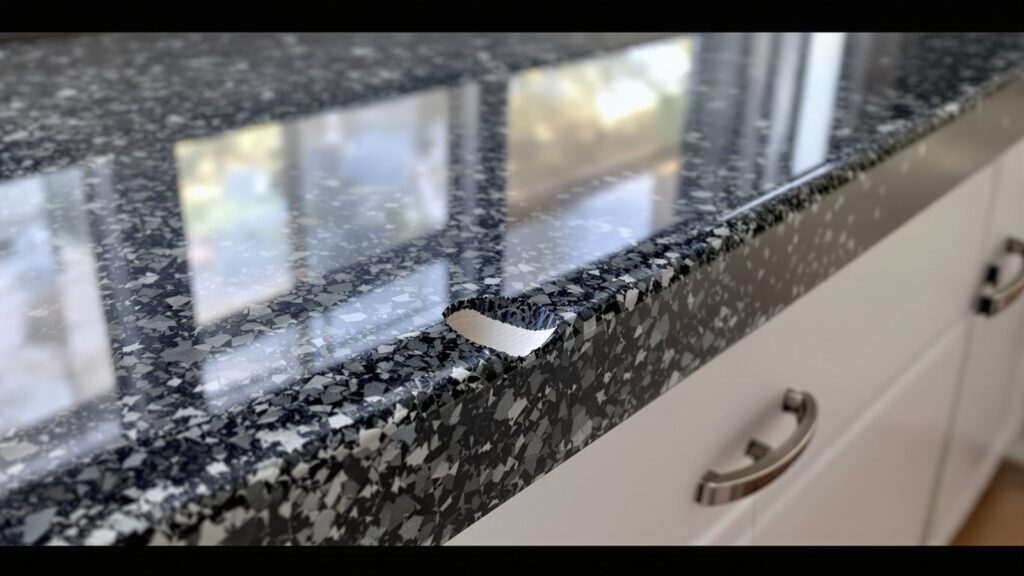
The honest answer is that a small chip can be filled with a kit, and a repair you cannot find takes more than a kit. The difference is almost entirely in the colour matching and the finishing.
The chip is filled with a resin matched to the colour and pattern of your granite, then finished level with the surface and the edge profile it sits on. On a stone with visible flecks and movement, the colour match is the part that decides whether the repair is invisible or obvious. The finishing is the part that decides whether you can feel it.
Worth knowing before you call: a fresh repair looks new. If the counter around it has any wear on it, the repaired patch can end up looking better than everything beside it, which is its own kind of visible. So the area around the repair usually gets brought back at the same time. On a newer installation there is less to match.
A small stable chip does not have to be fixed today. If it is about the size of a grain of rice, smooth to the touch and not catching anything, it is cosmetic and it is not getting worse. Where it is worth acting is when you can feel a ridge, when it catches a cloth or a fingernail, or when there is a hairline running away from it toward a seam or a cutout. Chips near an undermount sink or a stove cutout carry more risk, because the stone there is already under stress.
Need help with granite countertop repair?
Repair, in effectively every case. We have never seen anyone need a new slab because of a single chip.
Granite is solid stone throughout, so a chip or a crack is damage to part of a slab rather than a failure of the whole thing. What does justify a fabricator’s opinion is a crack running the full width or length, a section that has broken away entirely, or stone that is visibly moving because the substrate beneath it has failed. Those are structural questions and they sit outside restoration.
Everything short of that is worth having looked at, and looking costs nothing.
Nothing is quoted over the phone. A hairline crack in a photo can run further than it looks, and a chip near a cutout is a different proposition from the same chip in the middle of an island.
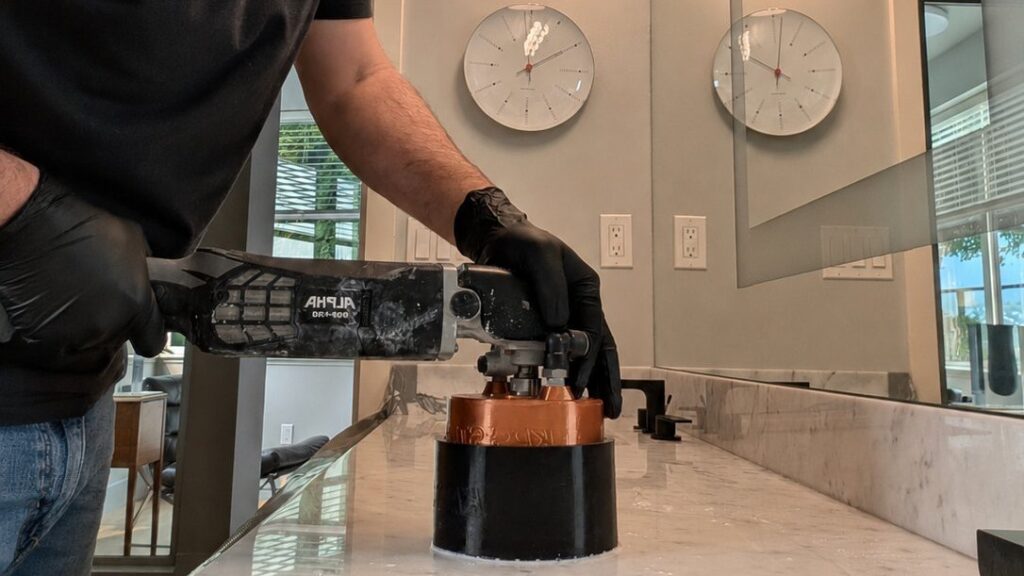
Dust free throughout. Water holds the dust down and what is left is captured at the tool, so the kitchen stays usable.
On timing, a single chip is often a few hours. It runs longer when the area around it needs bringing back, or when there is more than one thing to deal with. The real number is in your quote.
Chipped or cracked granite?
778-862-4998
We work through Vancouver and the Lower Mainland: Yaletown, Coal Harbour and False Creek, where the towers from the boom years have granite counters now 15 to 30 years old · downtown and the West End · Shaughnessy, Kerrisdale, Point Grey, Kitsilano and Dunbar · West Vancouver and the British Properties · North Vancouver, Burnaby, the Tri-Cities, Richmond, Surrey and White Rock.
In homes, granite is almost always on counters and islands. Granite floors are effectively a commercial thing, turning up in lobbies and elevator surrounds rather than houses.
What moves the price: the size of the surface, how bad the damage is, the stone and the finish. Our pricing page has the breakdown and the minimum service call.
A note worth reading if you are not certain what you have. A good share of the people who call us about granite turn out to have marble or limestone. The stones look alike and behave completely differently, and the repair is not the same. Send a photo and we will tell you which one you own before anyone books anything. If it is marble, limestone or travertine, our marble chip and crack repair page is the one you want.
Yes, and effectively always. Granite is solid stone through and through, so a chip is damage to one part of a slab rather than a failure of the whole thing. Replacement is a genuine question only when a crack runs the full width of the slab, a section has broken away, or the stone is moving because whatever supports it has failed.
The chip is filled with a resin matched to the colour and pattern of your granite, then finished level with the surface. The colour matching is where the skill sits: on a stone with visible flecks and movement, a generic white or clear filler reads as a scar no matter how well it is finished.
Heat, usually, rather than any weakness in the stone. Setting a hot pan straight onto granite is the most common cause we see, and the crack tends to follow a mineral vein where the stone was already a little softer. Cutouts make it more likely, because the slab is under more stress around a sink or a range. A crack needs stabilizing before anything else, since unlike a chip it can carry on moving.
No. A chip about the size of a grain of rice that feels smooth and is not catching on anything is cosmetic, and it will not spread on its own. Live with it until it suits you. What is worth acting on is a ridge you can feel, a chip that catches a cloth, or a hairline running away from it toward a seam or a cutout, particularly near a sink or a stove where the stone is under more stress.
Probably not, and on granite it is usually something simpler. Granite is very durable and it resists acid far better than marble, so true etching on it is rare. A dull area is more often fine scratching from an abrasive pad or steel wool. Most granite counters need nothing more than cleaning, polishing and sealing, which is a different job from repair and is on our granite polishing page.
Marble shows etching: dull, cloudy patches from wine, lemon juice or the wrong cleaner, where the shine has gone but the colour has not. Granite almost never does that, and it is harder and more resistant to scratching. Plenty of people call us about granite and turn out to have marble or limestone, so if you are not sure, send a photo and describe what happened. We would rather sort that out before a visit than during one.
Send a photo or call. We will look at it on site and tell you honestly whether it is worth doing.
Free estimate. No obligation.